Should Babies Sleep on Their Stomach or Back
Oft Asked Questions (FAQs) About SIDS and Safety Baby Sleep
Talk with your health care provider about whatever questions or challenges related to condom slumber practices for your baby.
The best way to reduce the gamble for SIDS is to always placeinfant on his or her back for all slumber times in a dissever sleep area, designed for a baby, with no soft objects, toys, or loose bedding.
Research shows that the back sleep position carries the lowest risk of SIDS.
Research too shows that babies who slumber on their backs are less likely to become fevers, stuffy noses, and ear infections. The back sleep position makes it easier for babies to look around the room and to motility their arms and legs.
Recall: Babies sleep safest on their backs, and every slumber time counts!
Currently, the American Academy of Pediatrics (AAP) Task Strength on SIDS indicates that at that place is not yet plenty evidence to say annihilation near the potential benefit or dangers of using cardboard boxes, wahakuras, or pepi-pods.
A business firm and flat slumber surface area that is fabricated for infants, like a rubber-approved* crib or bassinet, and is covered by a fitted sheet with no other bedding or soft items in the sleep area is recommended past the AAP to reduce the run a risk of SIDS and other sleep-related causes of infant death. Keeping infant in your room and shut to your bed, ideally for babe's first year, but at to the lowest degree for the first half dozen months is as well recommended past the AAP. Room sharing reduces the risk of SIDS. Having a separate safe slumber surface for baby reduces the likelihood of suffocation, entrapment, and strangulation.
You may desire to consider these questions earlier making a decision:
- Will all caregivers properly utilize the surface with no soft bedding or toys?
- Will all caregivers practice other safe baby sleep recommendations?
*A crib, bassinet, portable crib, or play yard that meets the safety standards of the Consumer Product Safety Commission (CPSC) is recommended by the AAP Task Force on SIDS. For information on crib safety, contact the CPSC at one-800-638-2772 or http://www.cpsc.gov.
Learn more than about safe infant slumber environments.
Cardboard boxes for babies are currently not subject to any Consumer Production Prophylactic Commission (CPSC) mandatory safety standards. These products do not come across CPSC's definition of a bassinet, crib, or handheld carrier. It is important to notation that CPSC does non have the authority to pre-approve or pre-test products for safety earlier they are sold.
Tell the CPSC if you have any safety concerns or problems with a baby-sized paper-thin box or other product. Contact the CPSC at http://www.SaferProducts.gov or (toll-complimentary) 1-800-638-2772.
Research shows that it is less dangerous to fall comatose with an babe in an adult bed than on a sofa or armchair. Before you first feeding your infant, think about how tired you are. If at that place's fifty-fifty a slight chance you might autumn asleep while feeding, avoid couches and armchairs. These surfaces can be very dangerous places for babies, particularly when adults fall asleep with infants while on them. If you retrieve yous might fall asleep while feeding your baby in an developed bed, remove all soft items and bedding from the bed before y'all outset feeding to reduce the take a chance of SIDS, suffocation, and other sleep-related causes of death.
No. Healthy babies naturally eat or coughing upward fluids—it's a reflex all people have. Babies may actually articulate such fluids better when sleeping on their backs because of the location of the opening to the lungs in relation to the opening to the stomach. In that location has been no increase in choking or similar problems for babies who slumber on their backs.
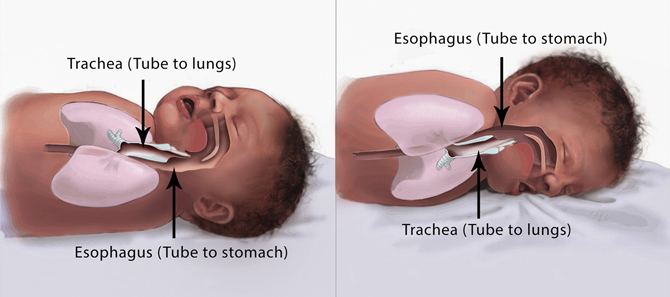
When the infant is in the back sleep position, the trachea (tube to the lungs) lies on tiptop of the esophagus (tube to the breadbasket). Anything regurgitated or refluxed from the tum through the esophagus has to work against gravity to enter the trachea and cause choking. When the babe is sleeping on its stomach, such fluids volition exit the esophagus and pool at the opening for the trachea, making choking much more probable.
Cases of fatal choking are very rare except when related to a medical status. The number of fatal choking deaths has non increased since dorsum sleeping recommendations began. In well-nigh of the few reported cases of fatal choking, an infant was sleeping on his or her stomach.
No. Caregivers were following advice based on the prove available at that time. Since and so research has shown that sleeping on the stomach increases the adventure for SIDS. This research also shows that sleeping on the back carries the lowest risk of SIDS, and that's why the recommendation is "back is best."
There is no evidence that swaddling reduces SIDS risk. In fact, swaddling can increase the risk of SIDS and other sleep-related causes of infant death if babies are placed on their stomachs for sleep or curlicue onto their stomachs during sleep.
If you decide to swaddle your baby, always place baby fully on his or her back to sleep. Finish swaddling infant one time he or she starts trying to ringlet over.
The baby's comfort is of import, but safety is more important. Parents and caregivers should place babies on their backs to slumber fifty-fifty if they seem less comfy or sleep more lightly than when on their stomachs.
A infant who wakes frequently during the night is really normal and should non be viewed as a "poor sleeper."
Some babies don't like sleeping on their backs at first, but virtually get used to it quickly. The earlier you start placing your baby on his or her back to sleep, the more rapidly your baby will adjust to the position.
No. Babies placed to sleep on their sides are at increased take a chance for SIDS. For this reason, babies should slumber fully on their backs for naps and at night to reduce the risk of SIDS.
Experts recommend skin-to-skin care for all moms and newborns for at least 1 hour afterward birth, in one case the mom is stable, awake, and able to respond to her baby. When mom needs to slumber or handle other things, babies should be placed on their backs in a bassinet.
In that location is currently no known way to preclude SIDS, nor are in that location any products that can prevent SIDS. Evidence does not back up the safety or effectiveness of wedges, positioners, or other products that claim to go on infants in a specific position or to reduce the risk of SIDS, suffocation, or reflux. In fact, many of these products are associated with injury and death, particularly when used in baby'south slumber expanse.
The U.S. Nutrient and Drug Administration, the Consumer Product Safe Commission, the American University of Pediatrics, and other organizations warn confronting using these products because of the dangers they pose to babies. Avoid products that become against safe sleep recommendations, especially those that claim to forestall or reduce the chance of SIDS.
No. Rolling over is an important and natural part of your infant'south growth. Most babies start rolling over on their ain around 4 to 6 months of age. If your babe rolls over on his or her own during sleep, you practice non need to turn the baby back over onto his or her dorsum. The important thing is that your infant first every sleep fourth dimension on his or her back to reduce the take chances of SIDS, and that there is no soft objects, toys, crib bumpers, or loose bedding nether baby, over baby, or anywhere in baby's sleep surface area.
Babies who usually sleep on their backs, only who are then placed to slumber on their stomachs, like for a nap, are atveryloftier risk for SIDS. Then information technology is of import foreveryone who cares for babies to e'er identify them on their backs to sleep, for naps and at night, to reduce the risk of SIDS.
Bumper pads and similar products that adhere to crib slats or sides are frequently used with the intent of protecting infants from injury. However, evidence does not support using crib bumpers to preclude injury. In fact, crib bumpers can cause serious injuries or death. Keeping them out of your baby's sleep surface area is the best way to avoid these dangers.
Before crib safety was regulated, the spacing betwixt the slats of the crib sides could be any width, which posed a danger to infants if they were too wide. Parents and caregivers used padded crib bumpers to protect infants. Now that cribs must meet condom standards, the slats don't pose the same dangers. As a upshot, the bumpers are no longer needed.
Yes, your infant should accept plenty of Tummy Fourth dimension when he or she is awake and when someone is watching. Supervised Tummy Time helps strengthen your infant's cervix and shoulder muscles, build motor skills, and prevent flat spots on the back of the caput.
Pressure on the aforementioned part of the baby's caput can cause flat spots if babies are laid downwards in the same position too often or for too long a time. Such apartment spots are usually not dangerous and typically get away on their ain once the babe starts sitting up. The flat spots also are not linked to long-term bug with head shape. Making sure your baby gets enough Stomach Time is one way to assist prevent these apartment spots. Limiting the time spent in car seats, in one case the baby is out of the auto, and irresolute the direction the infant lays in the sleep expanse from week to calendar week also can help to prevent these apartment spots. Check out the other things parents and caregivers tin do to foreclose flat spots on the back of the head. Visit the Other Means To Assistance Forestall Flat Spots on Infant's Head section of the website for more than information.
The majority (90%) of SIDS deaths occur before a baby reaches 6 months of age, and the number of SIDS deaths peaks between one calendar month and 4 months of age. Even so SIDS deaths can occur anytime during a baby'due south showtime year, so parents should yet follow safe slumber recommendations to reduce the risk of SIDS until their babe's beginning birthday.
SUID stands for "Sudden Unexpected Infant Death." SUID is divers as deaths in infants younger than 1 yr of age that occur all of a sudden and unexpectedly, and whose cause of decease is not immediately obvious prior to investigation.
SUID includes all unexpected deaths: those from a known cause, and those from unknown causes. SIDS and suffocation are both types of SUID. Most 1-half of all SUID cases are SIDS. Many unexpected infant deaths are accidents, but a disease or something done on purpose can also cause a baby to die of a sudden or unexpectedly. For some SUID, a cause is never institute.
SIDS stands for "Sudden Infant Decease Syndrome," and is the sudden, unexplained death of a baby younger than 1 year of age that doesn't have a known cause even after a complete investigation. This investigation includes performing a complete autopsy, examining the death scene, and reviewing the clinical history.
When a baby dies, health care providers, police force enforcement personnel, and communities endeavour to observe out why. They enquire questions, examine the baby, gather data, and run tests. If they tin can't find a cause for the death, and if the baby was younger than 1 year old, the medical examiner or coroner may call the death SIDS.
Other sleep-related causes of baby decease are those that occur in the slumber environment or during sleep time. They include accidental suffocation by bedding, entrapment (when a baby gets trapped between two objects, such as a mattress and wall, and can't breathe), or strangulation (when something presses on or wraps effectually a infant's neck, blocking the baby's airway). These deaths are not SIDS, but they are SUID.
Source: https://safetosleep.nichd.nih.gov/safesleepbasics/faq
0 Response to "Should Babies Sleep on Their Stomach or Back"
Postar um comentário