Stylized Art Conforms to a Set of Conventions Regarding the Representation of Form
Agreement Egyptian art lies in appreciating what information technology was created for. Ancient Egyptian art must be viewed from the standpoint of the ancient Egyptians not from our viewpoint. Hither nosotros explore the basis of Egyptian art.
Defining Manner
Understanding Egyptian art lies in appreciating what information technology was created for. Ancient Egyptian fine art must be seen from the viewpoint of the aboriginal Egyptians, not from ours.
The somewhat static, formal, abstruse, and often blocky nature of much of Egyptian imagery has led to it being compared unfavourably with more 'naturalistic,' Greek or Renaissance art. Merely the art of the Egyptians served a different purpose than that of these later cultures.
Another problem is 'What practise we mean past Style?'
- Was the Egyptian 'style' unlike from today's view of 'mode'?
Fashion is defined as 'how you lot exercise something.' Style should be distinctive and recognisable. Information technology is derived from the Latin stylus,significant writing implement, and was first concerned with the different writing of individuals. In art there are two aspects to mode and sometimes one manner dominates. In Egyptian art that is the example.
The beginning attribute is the individual style of the artist. This tin exist hard to make up one's mind with some cultures, and is generally indicated past the methods used to produce the art. This expanse of style can exist divided into assertive style which is personal to the artist and carries information supporting private identity then there is emblemic style which carries information about the grouping identity of the society the artist belongs to.
The second attribute of fashion is concerned with stylistic civilisation and is really a way of communicating or tranfering information. Egyptian fine art is dominated by this stylistic attribute.
What is hit about Egyptian art is that text accompanied almost all images. In statues the identifying text will appear on a back pillar supporting the statue or on the base. Relief or paintings usually have captions or longer texts that elaborate and complete the story in the scenes. Paintings and panels are frequently accompanied past hieroglyphs. Hieroglyphs are oftentimes works of art in themselves, fifty-fifty though many are instead phonetic sounds. Some stand for an object or concept which we call logographic which is a graphic that represents a give-and-take (Figure 1). Today the modern symbols used on road signs would exist logograms.
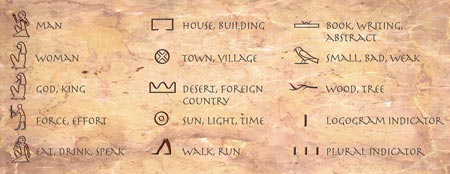
Figure 1: Egyptian logograms. Peter Bull.
When looking at a slice of Egyptian fine art the text and image are not ever clearly defined for example the determinative (a sign at the cease of a word that indicates identification of motility is determined past a pair of legs and the name of a man is shown by the image of a human being).
The exception to this Egyptian mode is the art from the menstruum of Akhenaten (1352 – 1336 BCE). He rejected the pantheon of gods in favour of one god and along with that radical move the fine art from this reign was dissimilar.
The proportions of the homo form are seen in extreme with large heads and drooping features, narrow shoulders and waist, modest torso, large buttocks, drooping abdomen and curt artillery and legs. We do not know why there was such a radical alter, and after his reign the art reverted to classical forms (Figure 2).
a)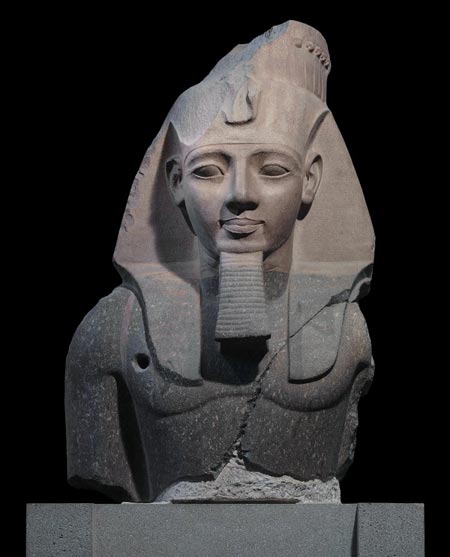 b)
b)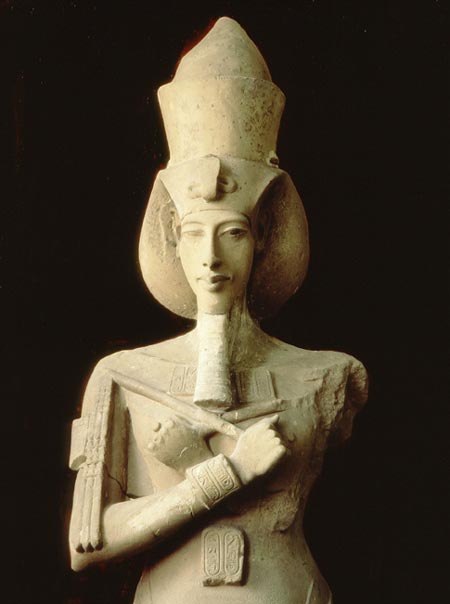
Figure ii: a) Rameses Two compared with b) Akhenaten, note the differences. a) © The Trustees of the British Museum, b) © The Art Archive / Alamy
Egyptian Way in Statues
While today we curiosity at the glittering treasures from the tomb of Tutankhamen, the cute reliefs in the New Kingdom tombs, and the serene beauty of Old Kingdom statues, it is important to recall that the majority of these works were never intended to be seen, that was not their purpose. And then when we look at them for style we can know the person past interpreting the accompanying hieroglyphs, merely the mode of decoration is also distinct and tells us something about the society.
- What was distinct about the mode of the Egyptian art?
- Can we place the conventions and, if so, what are they?
These images of high-status people, whether statues of gods or pharaohs or reliefs on tomb walls, were designed to benefit a divine or deceased recipient. The majority of Egyptian fine art exhibits frontality. This simply means they face direct ahead with merely one eye visible and both shoulders front facing and this can make them wait rigid (Figure 3).
- Were there other conventions of manner in Egyptian art?
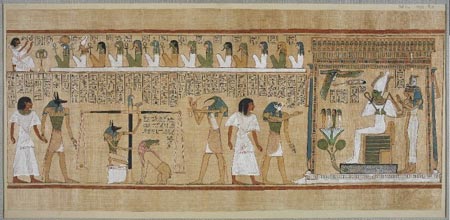
Effigy 3: Egyptian Book of the Dead showing the stylistic features. © The Trustees of the British Museum.
The main conventions of Egyptian art can be seen in Figure 3 higher up. Stylistic conventions adopted by every creative person in aboriginal Egypt included not merely 'Frontality' but also 'Axiality'. The rules of axiality meant figures were placed on an axis.
Proportions of figures were related to the width of the palm of the hand so at that place were rules about proportions of head to torso. The faces did non express emotions.
The sizes of figures were determined by their importance. The proportions of children did non change; they are merely depicted smaller in calibration. Servants and animals were usually shown in smaller scale. In guild to clearly define the social hierarchy of a situation, figures were fatigued to sizes based non on their distance from the painter'south point of view but on relative importance. For example, the Pharaoh would be drawn every bit the largest figure in a painting no matter where he was situated, and a greater God would be drawn larger than a lesser god.
Axiality, proportion and hieratic scaling bespeak that Egyptian artists would have had to use mathematics to construct their composition. Ancient Egyptian artists used vertical and horizontal reference lines in order to maintain the right proportions in their work. In many tombs the walls withal conduct these grids used to ensure the conventions were kept to past the lower and amateur artists working for the master creative person. Political and religious, also equally creative order was maintained in Egyptian art.
Of import figures were non usually depicted overlapping, but figures of servants were. Each object or element in a scene was designed and fatigued from its most recognizable angle. The objects in a scene were so grouped together to create the whole. This is why images of people show their face, waist, and limbs in contour, simply the middle and shoulders are shown facing frontally. These scenes are composite images designed to provide complete information most the relationship of the objects to each other, rather than from a single viewpoint.
Rules were too applied to the poses and gestures of the figures to reflect the pregnant of what the person was doing. An ancient Egyptian artist would draw a figure in an act of worship with both artillery extended forward with hands upraised.
They did not attempt to replicate the existent globe only did reach a realistic dialogue betwixt the iii dimension globe and their paintings by the employ of position and group to correspond depth so the background is shown above the figure the foreground below or to one side.
Most formal statues show a prescribed frontality, pregnant they are arranged to look directly ahead, because they were designed to face the ritual being performed before them.
Oftentimes this is in a temple or tomb such equally the row of iv colossal statues of Rameses II outside the main temple at Abu Simbel (Figure 4). They were designed to face up the rising lord's day and so important in Egyptian organized religion.
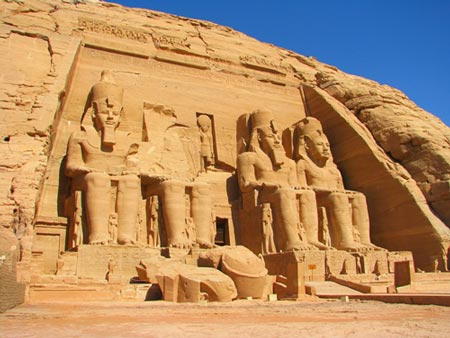
Figure four: Statues of Rameses 2 at Abel Simbel. © Shutterstock.
Statues were prepare upwardly to accept office in the rituals relating to the gods and the pharaoh. Many statues were as well originally placed in recessed niches or other architectural settings; contexts that would make frontality their expected and natural mode. Others were placed against pylons or along an artery to the temple as in Figure five.
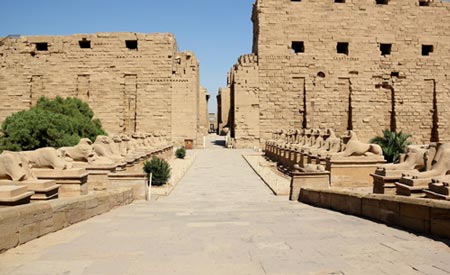
Figure 5: Artery of Sphinxes and get-go pylon at western entrance to Precinct of Amun Re Karnak Temple. © Shutterstock
Statuary, whether divine, royal, or elite, provided a conduit for the spirit (or ka) of the represented existence to collaborate with the earthly realm. Divine cult statues (few of which survive) were the subject area of daily rituals. Those rituals would include those of clothing, anointing, and perfuming with incense the statue. Sometimes they came out of the temple and were carried in processions for special festivals, so that the people could "see" them even though they were almost all entirely shrouded from view in wooden arks, but their 'presence' was felt.
The reason for this frontality is they were designed not equally an art form but every bit part of a religious ritual. The Egyptians did not take a word for art but they had words for statue, stelae or tomb. They had a sense of the aesthetic but within a office. Art is then functional within the faith.
Woods and metal statuary to represent generic figures and these in dissimilarity to the ritual statues were more than expressive. The arms could be extended and hold split objects, spaces between the limbs were opened to create a realistic appearance, and more than positions were possible. Fifty-fifty then the art conventions were kept to (Figure 6).
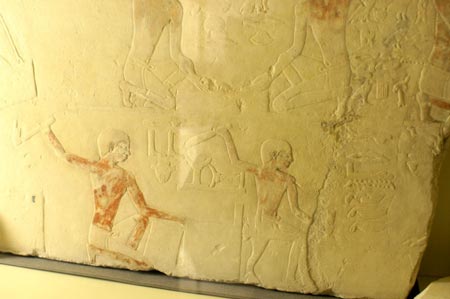
Effigy 6: Relief of craftmen. Pat O'Brien
Rock, wood, and metal bronze of elite figures all served the aforementioned functions and retained the same type of formalization and frontality. Only statuettes of lower status people displayed a wide range of possible actions, and these pieces were focused on the deportment, which benefitted the elite owner, not the people involved.
Hence these generic figures were frequently put in tombs to serve the tomb owners in the afterlife every bit bakers, scribes and other occupations. They were there as shabti probably adult from the retainer figures common in tombs of the Middle Kingdom. They were shown as mummified like the deceased, with their own bury, and inscribed with a spell to provide food for their main or mistress in the afterlife. Alternatively in that location can be models of the servants both sorts can exist seen in Figure 7, beneath.
a)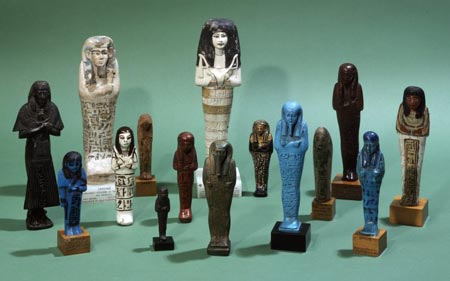 b)
b)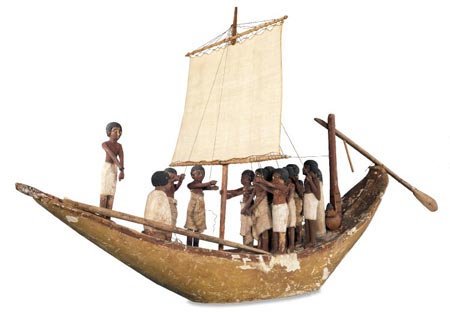
Figure 7: a) Shabti figures; b) model of a sailing ship. © The Trustees of the British Museum.
Modest figures of deities, or their animal personifications, are very mutual, and institute in popular materials such as pottery. There were besides large numbers of small carved objects, from figures of the gods to toys and carved utensils. Alabaster was often used for expensive versions of these; painted wood was the most mutual material, and normal for the small models of animals, slaves and possessions placed in tombs to provide for the afterlife.
3-dimensional representations, while existence quite formal, besides aimed to reproduce the existent-globe—statuary of gods, royalty, and the elite was designed to convey an idealized version of that individual. Some aspects of 'naturalism' were dictated by the material. Rock bronze, for example, was quite closed—with arms held close to the sides, express positions, a strong back pillar that provided support, and with the fill spaces left between limbs
Arab republic of egypt Mode in Paintings and Relief
Paintings demonstrated two-dimensional art and as a result it represented the earth quite differently. Egyptian artists used the ii-dimensional surface to provide the about representative aspects of each object in the scene.
- Does the painted art also show the same conventions?
Egyptian artists worked in two dimensions only and so the best characterisation of the object was the view the artist used. Once more they used the ideas of frontality, axiality and proportionality. So when creating the human form the artist showed the caput in profile with full view eye line parallel with the shoulder line while the chest, waist, hips and limbs are in profile. However, if there is neck jewellery to be shown it is shown in full (Figure 8).
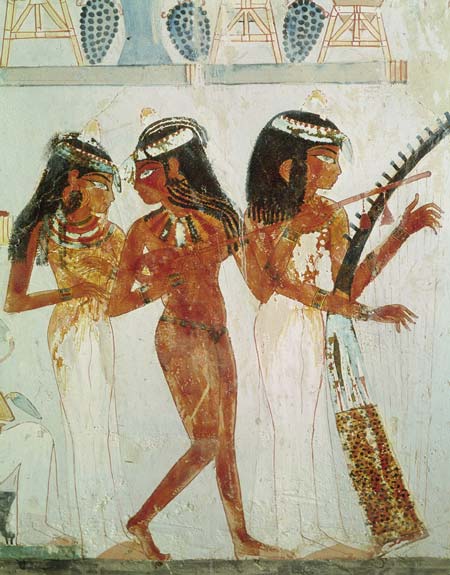
Effigy 8: Musicians, Tomb of Nakht. © The Art Gallery Drove / Alamy.
Scenes were ordered in parallel lines, known as registers. These registers split up the scene as well as provide footing lines for the figures. Scenes without registers are unusual and were mostly only used to specifically evoke chaos; battle and hunting scenes volition often show the prey or foreign armies without ground lines. Registers were also used to convey data near the scenes—the higher up in the scene, the higher the status; overlapping figures imply that the ones underneath are farther away, as are those elements that are higher within the annals.
Smashing observation, exact representation of actual life and nature, and a strict conformity to a set of rules regarding representation of three dimensional forms dominated the grapheme and mode of the art of aboriginal Egypt. Completeness and exactness were preferred to prettiness and cosmetic representation. The use of mathematics to create the art is also very evident in many of the incomplete art forms indicating that Egyptian artists used some mathematical formulas to create order in their art.
Because of the highly religious nature of Ancient Egyptian civilisation, many of the corking works of Aboriginal Egypt depict gods, goddesses, and Pharaohs, who were too considered divine. Ancient Egyptian art is characterized by the idea of order. Clear and simple lines combined with simple shapes and flat areas of colour helped to create a sense of club and balance in the art of ancient Arab republic of egypt.
Symbolism played an important function in establishing a sense of club this ranged from the pharaoh'south regalia (symbolizing power to maintain order) to the individual symbols of Egyptian gods and goddesses. Animals were also highly symbolic figures in Egyptian art.
Colours of the subjects were more expressive rather than natural. Then a carmine skin implied hard working tanned youth, whereas yellow peel was used for women or centre-aged men who worked indoors. The presence of blue or gold indicated divinity. The utilise of black for royal figures expressed the fertility of the Nile. Stereotypes of people were employed to indicate geographical origins.
Difference in scale was commonly used for carrying bureaucracy. The larger the scale of the figures, the more of import they were. Kings were oft shown at the same scale as the deities, and both are shown larger than the elite and far larger than the general populace and in smallest scale are shown servants, entertainers, animals, trees, and architectural details. And so the size indicates relative importance in the social order.
Ancient Egyptian art forms are characterized by regularity and detailed depiction of gods, human beings, heroic battles, and nature. A high proportion of the surviving works were designed and made to provide peace and assistance to the deceased in the afterlife. The artists' desire was to preserve everything from the present as clearly and permanently as possible. Ancient Egyptian art was designed to represent socioeconomic condition and belief systems.
The Egyptians used the distinctive technique of sunken relief, well suited to very vivid sunlight. The main figures in reliefs attach to the aforementioned figure convention as in painting.
Papyrus was used by aboriginal Egyptians and it was exported to many states in the ancient earth for writing and painting. Papyrus is a relatively frail medium mostly lasting effectually a century or two in a library, and though used all over the classical world has only survived when cached in very dry out weather condition, then, when found, is often in poor status.
Source: https://edu.rsc.org/resources/principles-of-egyptian-art/1622.article
0 Response to "Stylized Art Conforms to a Set of Conventions Regarding the Representation of Form"
Postar um comentário