How to Read a Wheel Alignment Printout
Take you ever talked to your vehicle's auto technician and just nodded your caput feigning understanding? You nod along in agreement every bit automotive terms go in one ear and correct out the other. So, yous're handed a slice of paper with an illustration of a car, some ruby-red, green, and yellowish colors, and a bunch of numbers that make absolutely no sense.
Deciphering this report on your own could leave yous feeling like you're trying to solve a riddle, just it doesn't have to exist. With our guide you'll learn how to read a wheel alignment report merely like the pros and the side by side time you're talking with your technician, y'all'll nod forth with complete understanding.
What Is A Wheel Alignment?
Alignment is function of the suspension arrangement and is the geometric measurement of how the wheels fall into line and rotate at the same speed and management. When your vehicle rolls off the assembly line at the manufacturer, engineers have determined and prepare the vehicle to the appropriate alignment specifications. 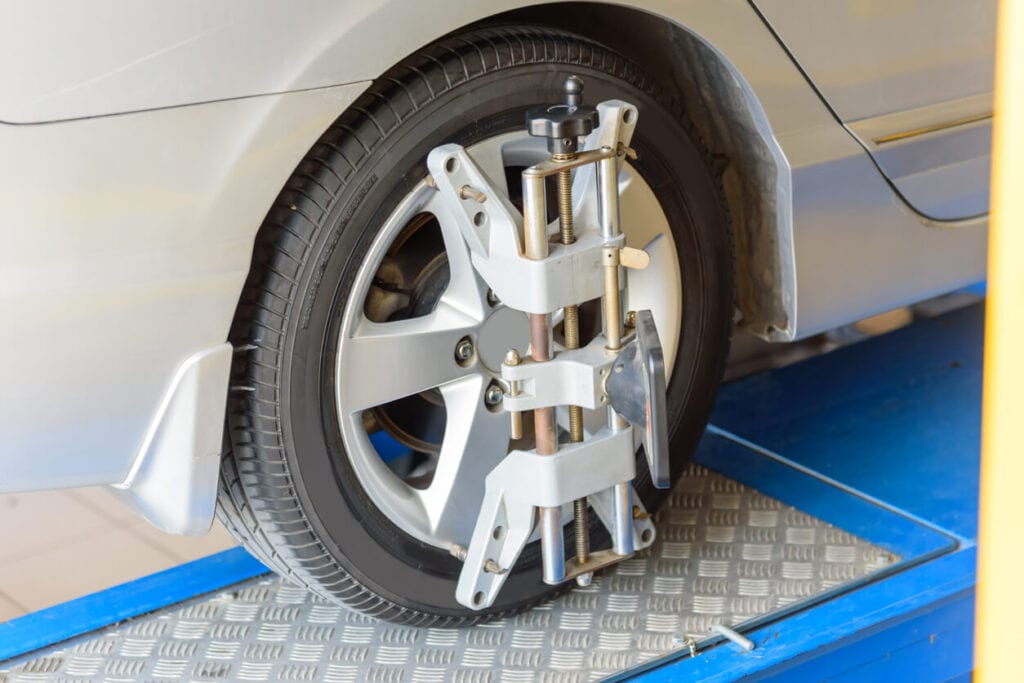
With use, the occasional bump against a curb, or new tires, the vehicle falls out of alignment . Though it doesn't happen overnight, gradual changes affect the alignment in your vehicle eventually requiring the need for an alignment.
That's why it'due south a adept idea to have your alignment checked at least one time per year.
The alignment system is measured in three unlike areas including camber, caster, and toe. An aligning is needed when either of these angles autumn out of their predetermined specifications.
How To Read Wheel Alignment Specifications
Camber
Camber measures the angle that the bike and tire stand relative to the road. Camber is typically positioned with a slight angle every bit opposed to completely upright which helps weigh forces due to cornering.
- Positive Camber occurs when the wheels lean abroad from the vehicle at the height. Besides much positive camber results in tire habiliment on the outside of the tire.
- Negative Camber occurs when the wheels lean toward the eye of the vehicle at the top. Excessive negative camber will result in clothing on the inside of the tire.
Pulley
Caster measures the angle from height to bottom of the steering axis related to the pause components at the wheel. Simply put, pulley is what ensures your vehicle drives in a direct line while also providing directional stability to return to that position afterwards completing a turn.
- Positive Caster occurs when the load is ahead or there is pulling on the spindle. Likewise much caster indicates that the vehicle's rear is lower than the recommended vehicle summit which causes the front interruption to shift to a more positive caster. If ane bicycle'southward caster is more positive than the other, the wheel will force the vehicle to pull in that wheel's direction.
- Negative Caster makes steering exceedingly sensitive at high speeds and reduces the wheel'south directional returnability in one case turns are completed.
Toe
Toe measures the direction that the wheels are rolling. It is imperative that a vehicle's wheels all roll in the aforementioned direction at the same fourth dimension.
- Positive Toe also known as Toe-in occurs when the wheels are turned in.
- Negative Toe also known as Toe-out occurs when the wheels are turned outward. The number of toe is usually simply a fraction of a degree. Toe should be adjusted to guarantee all wheels roll parallel together in synchrony. Poor toe alignment, whether positive or negative, reduces steering ability and causes tires to article of clothing prematurely.
Reading Your Bicycle Alignment Report
When the alignment process begins, the technician will use an alignment machine to measure the vehicle. The automobile and so generates a written report that indicates the vehicle'southward current specifications, what should wheel alignment exist for your particular vehicle, and the degree of aligning to attain correct alignment for both front and rear wheels.
Hither's how to determine whether your vehicle has also much or too little camber, caster, or toe at a glance:
By Color
Many alignment reports are printed in total color to assistance the reader identify which angle is likewise positive or too negative. Only like a finish calorie-free, light-green means go, yellow ways caution, and red ways stop. So, too, does the alignment report. Red oftentimes indicates that the alignment is too negative or positive while greenish ways the measurement is right on target. In some cases the written report will print yellow to indicate to the reader that the alignment is budgeted the predetermined limit.
By Number
Within or abreast the colors, there are numbers that are measured in degrees to betoken the variances in the bending of measurement. For example, a negative number identifies when there is not plenty angle in camber, pulley, or toe while a positive number indicates when in that location is as well much angle. Whether positive or negative, both numbers indicate adjustments need to be made in the opposing direction.
Wheel Alignments and Sun Machine Service
Now that you understand how to read an alignment report, schedule your next alignment with Sun Auto service . Our skilled technicians employ only the almost sophisticated alignment machines to guarantee your vehicle is aligned to the specifications set up forth past your vehicle manufacturer–all in about an hour!
Even so accept questions nearly alignments and alignment reports? We love questions! Our friendly Service Advisors and Technicians are happy to answer all your questions. Give the states a telephone call or stop in today.
Source: https://www.sunautoservice.com/how-to-read-a-wheel-alignment-report/
0 Response to "How to Read a Wheel Alignment Printout"
Postar um comentário