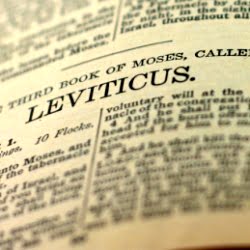
Leviticus and same-sex relations
 I have written a Grove booklet onSame-sexual practice Unions: the primal biblical texts which you can buy from the Grove website. It explores, briefly, all the master biblical texts in the Erstwhile and New Testaments which come up in the debate on the upshot.
Here is the chapter on the ii texts in Leviticus.
Leviticus 18 and xx
Practise not have sexual relations with a man equally ane does with a woman; that is insufferable. (Lev xviii.22)
If a homo has sexual relations with a homo as 1 does with a woman, both of them have done what is detestable. They are to be put to expiry; their blood volition be on their own heads. (Lev 20.13)
Traditionalist Reading
Although nosotros exercise not now follow the penalties prescribed for these offences, the texts show how serious is the prohibition on same-sex sex activity. It comes not in the context of cultic activity, but in full general regulations about sexual conduct, and reflects the cosmos narrative of Gen ane and ii.
Revisionist Reading
The prohibition is ready in the context of God's people being distinctive from the worshipping practices of the cult of Molech, and so is nearly likely referring to homosexual cult prostitution. It is set within an outlook concerned with being clean rather than defiled, and we no longer share this outlook or its implications.
Exposition
Leviticus reflects a priestly business with holiness and club; other OT texts highlight different sets of concerns, merely this focus links with the commencement creation account (in Gen 1), which is often identified with a 'priestly' influence. These texts come within a section of Leviticus known as the 'holiness code' (Leviticus 17–26), which consists of terse, tightly packed commands focusing on holy living as a singled-out feature of God'due south people, in dissimilarity to the nations around them.
The context of chapter xviii is ready by the introductory phrase, 'I am the Lord your God' (v ii), reminding the hearers of God'due south initiative in delivering them from slavery in Egypt. 17 In this way, the regulations here are offered as a response to God's telephone call and initiative, and involve embracing a distinct design of life from the surrounding nations as a reflection of God'due south holiness. Paul reinterprets Lev 18.5 ('Whoever does these things volition live by them') to contrast the oppression of 'constabulary' with the liberty of grace. But in its context here, this poetry suggests that these commands are to be received equally life-giving, liberating disciplines.
OT constabulary has two features which makes information technology distinct from ancient near eastward (ANE) law codes:
- Alongside 'casuistic' law, involving specific cases or situations, OT law gives particular emphasis to 'apodictic' law—general principles, usually as a reflection of the character of God—including concentrations in sections of fundamental importance such as the X Commandments. Other ANE codes focus much more on casuistic constabulary.
- OT law has a much more restrictive arroyo to sexual ideals in general, and same-sex activity in particular, compared with other ANE law codes. The context of this is the preservation of family life as the basic building block of society; the 'good life' is expressed in harmonious family living. The purpose of the law is to support and sustain this, rather than to protect individual rights.
Where the narrative texts use 'know' as a metaphor for sexual relations, this chapter mostly uses the phrase 'to uncover the nakedness of…' xviii The consequent theme here is the setting of boundaries for sex activity out of a concern for purity, and the effect of this is the protection of various arenas of life from sexual activity. The prohibition on same-sexual practice action is set alongside prohibitions on incest, animality and the cede of children. The whole listing of prohibited activities is called 'detestable' (Hebrew toevah, translated 'abomination' in the AV) in the summary annotate in 18.30, but in 18.22 aforementioned-sex activity is singled out with this term, and in the following verse animality is similarly highlighted as a 'perversion' (NIV). As with other regulations, these are not narrowly cultic but form part of a shared, national life for all who reside in the land (Lev 18.26), including 'resident aliens' who do not participate in cultic action.
In verse 22, at that place is a change in the metaphor used for sexual relations which is non evident in all English translations. The phrase itself is very specific, literally, 'With a male y'all volition non lie on the lyings [beds] of a woman, abomination it [is].' The use of 'male' (zaqar) alongside 'homo' and 'woman' (ish and ishshah) creates an repeat of the creation accounts in Gen one and 2; it is plausible to see the serious nature of the offence as reflecting its rejection of God's cosmos order of 'male person and female.' Since the phrase is quite general, there is no suggestion that the outcome here is marital unfaithfulness, which is dealt with elsewhere.
The stiff term toevah is used in a cultic sense of unacceptable sacrifices, or idolatry, both of which are 'detestable.' But its use is non limited to that. It is applied to distinct eating habits (Gen 43.32), more than general racial contempt (Gen 46.34), prohibited foods (Deut 14.3), magic and spiritism (Deut 18.12), remarrying someone you have divorced (Deut 24.4) and the use of dishonest weights and measures (Deut 25.16). It is quite striking in Lev xviii and 20 that the term qadesh, significant male shrine prostitute (as in Deut 23.17–18), is absent. The context in Leviticus is everyday and specially family life as the holy people of God. If there are hints of cultic linguistic communication this is not because the prohibitions are located in cult but considering the whole of life is to reflect the purity and holiness of Israel's God.
There are three wide areas of critique of the traditional reading of these verses.
1 Patriarchy
The showtime objection is that these prohibitions are related to patriarchy; aforementioned-sex relations threaten male potency of women, particularly as a homo is taking the submissive female part in the sexual practice human activity, and for this reason are to be rejected. It is worth noting that these commands do announced to be addressed to the men in the community as the principal moral agents (a contrast with NT ethical texts). Nonetheless, there is no articulate patriarchal shape to the prohibitions, and the explicit prohibition on sibling polygamy in Lev 18.18 sets a clear limit on such patriarchal power as might be nowadays. xix In Lev 20.x, at that place is symmetry in moral responsibleness betwixt those who commit adultery, with both partners being held accountable; the control shows no involvement in any imbalance of power relations arising either from patriarchy or from abusive relations. (This offers an interesting perspective on the story in John viii of the adult female caught in adultery; where was the cheating man?)
The prohibition in Lev xviii.22 is non on acting as a woman with a human being, but on acting with another man who is taking the role of the adult female. To put it crudely, the prohibition is not on being penetrated (by some other man) just on penetrating. In other words, the poetry gives no suggestion that the human activity is seen as a breach of manliness or the human'southward honor; rather, the result appears to be the failure of this human activity to match the divinely given creation guild from Genesis. (Information technology is interesting, though, to note in that location is no reference in either Lev xviii or 20 to the importance of procreation; the same-sex activity human activity is non condemned for declining to satisfy the creation command to 'be fruitful and multiply.')
2 Anthropological Reading
A 2d objection is that the prohibition on same-sex action belongs to a nomenclature of life into categories of the 'make clean' and the 'unclean' that we exercise not share. The system of sacrifices and prohibitions in Leviticus seems baffling and confusing to many mod readers. A pregnant contribution to making sense of this text has been offered by taking an anthropological approach, which involves a sympathetic reading that seeks to enter the symbolic globe of these texts in their ain terms in order to understand their 'inner logic.' 20 Ii of import insights sally from this.
The first is to recognize within the text a 'graded' understanding of holiness, where some areas are not holy, others are more than holy, and even so others constitute the 'holy of holies'—all based on their concrete proximity to the presence of the holy God. Philip Jenson explains it thus:
Within Israel itself some spaces and some Israelites are holy in means that others are not. This kind of graded holiness can be seen virtually clearly in the architecture and symbolism of the Tabernacle…This spatial mark of graded holiness correlates with the personal dimension. The nearer the centre, the more than restricted are those who can enter, and then at special times and in special means. 21
Every bit people move from one 'level' of holiness to another, they must undergo sure rituals that involve the offering of sacrifices. Although mod thinking might find it difficult to appoint with this system, information technology has an important theological bespeak to information technology:
The arrangement of graded holiness allows us to safeguard God's absolute holiness, while at the same approaching him to the degree that we are able. 22
The other key insight arising from this approach is the stardom betwixt sin and impurity. Sin is the result of disobedience to the commands of God, and results in guilt which can only be removed by the appropriate cede. Impurity, on the other paw, can be acquired by blow, without any intention on the office of the person who has get impure. This, too, is remedied by ways of sacrifice, just information technology does not imply guilt in the same style every bit sin.
'Common' (sometimes translated 'profane') is a general term for the not-holy, which includes both the make clean and the unclean. Above all the holy has to be kept apart from the unclean, for the unclean represents what God is non. 'Make clean,' on the other hand, is a neutral term. To be clean is a stepping-rock either towards the holy (through induction) or the unclean (through defilement). Becoming unclean is often simply function of ordinary life, but deliberately bringing the unclean into contact with the holy is a serious sin, for it shows antipathy for the holy God. 23
So, it is argued by revisionists, the distinction between beingness clean and unclean is non every bit important every bit the stardom between holiness and sin. And the language of Leviticus eighteen and 20 is that of 'defilement' (or 'uncleanness') rather than 'sin.' This means that same-sex relations belong to a blueprint of cleanness versus defilement to which we no longer subscribe, rather than the pattern of holiness versus sin which we do.
The weakness in this argument is that the relation between these ii patterns is rather more than complex. To be impure might not imply sin, merely to sin does brand one impure—and then these terms can, in fact, overlap. And that is precisely the instance in Leviticus 18 and 20. Although 'exist defiled' (tame') is the about common term in Leviticus 18, at 18.25 this is identified with sin, and being the reason for the state 'vomiting out' its inhabitants equally a sign of God's judgment. This forms function of the wider business of the whole of the 'holiness code'; it places the whole question of ethics under the question of purity, so that wrong action is seen as an offense against God's holiness, non just confronting his justice. Purity is concerned with moral activeness, not ritual action lone.
iii Cult Prostitution
Steve Schuh offers a third common objection to the traditional understanding: the texts here prohibit homosexual prostitution in the context of heathen worship, but are not relevant to aforementioned-sex activity in other contexts. 24
Schuh highlights the importance of cultic distinctiveness through the OT narrative—God is not to be worshipped in the manner that other gods are worshipped—and how God's people repeatedly failed to observe this. He besides notes the adequately frequent mention of male shrine prostitutes in the 'Deuteronomistic' history (Deuteronomy, Joshua, 1 and 2 Samuel, 1 and 2 Kings). He notes a connection with the Leviticus texts, in that one Kgs 14.24 also uses toevah, 'abomination.' As Robert Gagnon notes, 'Homosexual cult prostitution appears to have been the primary form in which homosexual intercourse was practiced in State of israel.' 25
From this Schuh concludes that 'The homosexual acts prohibited in Leviticus 18 and 20 are described in the immediate context of idolatry and therefore very probable refer to ritual acts of male homosexual prostitution.' Hither he appears to brand a social, a textual and a logical mistake. As noted above, these texts are not particularly focused on the cult; the prohibition on child sacrifice appears to focus more on the child than the cede; these regulations are about family relations and the protection and preservation of the family unit unit, not about cultic worship. And, logically, he appears to exist maxim that, because homosexual shrine prostitution is a (perchance primary) instance of 'detestable' do, it must be the only i. This is like maxim that because apples are a mutual kind of fruit, all fruit must be apples. Information technology is quite striking that the term for cult prostitute used elsewhere is lacking here—something that Schuh fails to note in his discussion, and which considerably weakens his argument. Instead, the language draws on the full general terms from Genesis ane and 2. And, as Gagnon points out, the logic of Schuh's observation is the opposite of what he concludes. In other Mesopotamian cultures, there was a general rejection of aforementioned-sex activeness; the one area information technology was tolerated was in the pagan cult. If Leviticus is rejecting this, information technology is rejecting the nigh acceptable form of same-sexual practice activity in its context, not (as we might suppose) the least acceptable grade. The unqualified and general rejection of all male same-sex penetrative activeness, any its context, in Leviticus is without parallel in other ANE texts. 26
So these Leviticus texts are expressing a broad prohibition on same-sexual practice sex. They do so in general terms, in the context of cartoon boundaries around sexual activity for the sake of purity, and alluding to the cosmos narratives. Although a significant example of such 'detestable do' is establish in male shrine prostitution, these texts do not brand reference to this, and exercise not appear to have this specifically in view. Instead, the prohibition is continued to language of sin and holiness which Christians would however want to describe on.
17 Compare the introduction to the X Commandments in Exod 20.2 and Deut 5.6.
eighteen The use of a like phrase in Gen 9.22 leads some commentators to conclude that Ham's sin was to accept forced same-sexual practice activeness with his father Noah, though others regards the show for this as weak.
19 In fact, the Leviticus texts do not appear to envisage the possibility of polygamy, unlike Deut 17.17 and 21.15.
20 A key proponent of this style of reading was Mary Douglas.
21 Philip Jenson, How to Read Leviticus (Grove Biblical booklet B67) p 7.
22 Jenson, ibid, p 8.
23 Jenson, ibid, p 13.
24 'Challenging Conventional Wisdom,' http://world wide web.backbone.org.united kingdom/articles/Challenging.shtml
25 Robert A J Gagnon, The Bible and Homosexual Do: Texts and Hermeneutics (Nashville, TN: Abingdon, 2001) p 130.
26 See Gagnon's business relationship of the ANE documents in The Bible and Homosexual Practice pp 44–66.
If y'all enjoyed this, do share it on social media (Facebook or Twitter) using the buttons on the left. Follow me on Twitter @psephizo. Like my folio on Facebook.
Much of my piece of work is done on a freelance ground. If you lot have valued this post, you can make a unmarried or echo donation through PayPal:
Comments policy: Expert comments that engage with the content of the post, and share in respectful debate, tin add real value. Seek first to understand, and then to be understood. Brand the most charitable construal of the views of others and seek to learn from their perspectives. Don't view debate as a conflict to win; address the argument rather than tackling the person.
Source: https://www.psephizo.com/biblical-studies/leviticus-and-same-sex-relations/
0 Response to "Leviticus and same-sex relations"
Postar um comentário